
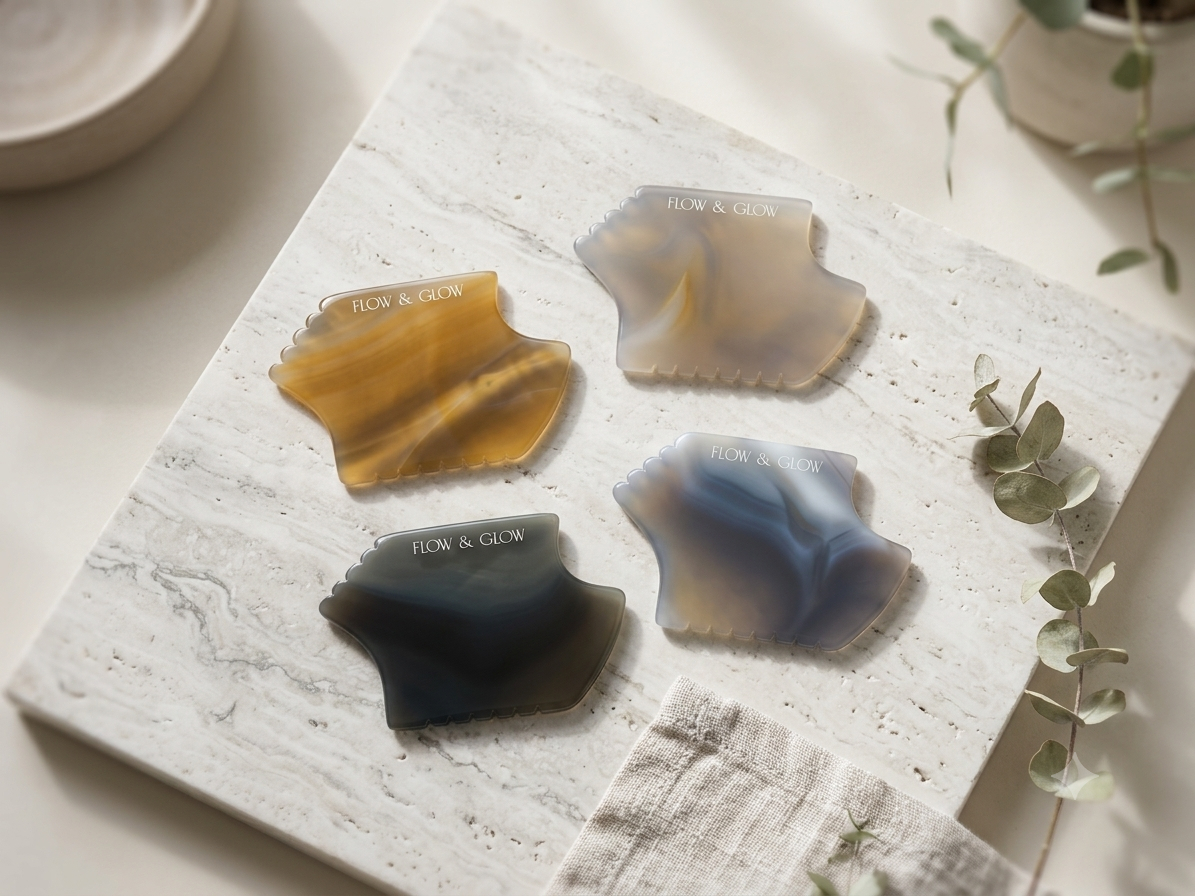
You've seen it all over your feed, A smooth stone tool being glided across someone's face in slow, intentional strokes. Gua sha has taken the modern wellness world by storm, and for good reason. But what most people scrolling past those videos don't realize is that this practice has been quietly doing its job for over two thousand years, long before it had an aesthetic and a hashtag.
At Flow & Glow Wellness, we believe that understanding the tools you use on your body makes your practice more intentional, more powerful, and more effective. So today we're breaking it all down: where gua sha came from, what science says it actually does, and how to use it correctly so you get real results.
Where It All Began
Gua sha - pronounced "gwah-shah" is a healing technique that originated in ancient China with roots stretching back over 2,000 years. The name itself is straightforward: "gua" means to scrape, and "sha" refers to the redness that sometimes appears on the skin after treatment, a sign that stagnant blood and energy is being moved to the surface.
In traditional Chinese medicine, gua sha was originally a full-body treatment applied to the back, neck, shoulders, and limbs to release what practitioners called "sha qi" blocked, stagnant energy that they believed caused pain, fatigue, and illness. It was a trusted household remedy used by healers and families alike, performed with smooth stones, coins, ceramic spoons, or whatever tool could create that deliberate scraping motion against oiled skin.
"Gua sha was never a trend. It was a therapy trusted by generations of healers long before wellness became an industry."
Over centuries the practice spread across Southeast Asia, becoming woven into Vietnamese, Korean, and Indonesian healing traditions under different names "cao gio" in Vietnam, "kerik" in Indonesia. Each culture adapted it to its own understanding, but the core principle stayed the same: move what is stuck, restore what is depleted.
It wasn't until relatively recently that Western researchers began studying gua sha clinically and what they found validated what traditional practitioners had understood for centuries.
What Gua Sha Actually Does to Your Body
Modern research has confirmed that gua sha creates real, measurable changes in the body. This isn't a placebo or a beauty myth; there is genuine science behind why it works. Here's what's happening beneath the skin with every stroke:
Microcirculation
The scraping motion increases blood flow to the surface tissues, delivering fresh oxygen and nutrients while flushing out metabolic waste that builds up in stagnant areas.
Lymphatic activation
Gentle directional pressure stimulates the movement of lymphatic fluid, reducing puffiness and supporting your body's natural detoxification and immune response.
Fascia release
The gliding motion breaks up adhesions in the connective tissue beneath the skin, releasing held tension in the face, jaw, and neck that most of us carry without realizing it.
Collagen stimulation
The gentle friction signals the skin to produce more collagen, supporting firmness, elasticity, and a healthy glow that compounds with consistent, regular use.
A notable study published in the Journal of Hematology & Oncology found that gua sha significantly increases an enzyme called HO-1 in the body, which carries powerful anti-inflammatory properties. This is part of the reason gua sha has been used for centuries to ease pain, reduce swelling, and accelerate healing, the science is finally catching up to the tradition.
For the face specifically, the lymphatic benefits are where the most visible results live. The face has a dense network of lymphatic vessels, and because we hold so much tension in our jaw, neck, and brow often without even noticing stagnation builds up quickly. Regular gua sha practice keeps that fluid moving, which is why consistent users see reduced puffiness, clearer skin, and more defined contours over time.
How to Use It Correctly
The single most important rule of gua sha is this: never use it on dry skin. Always apply a facial oil or serum first. Without that slip, the tool can drag and irritate which is the opposite of what you want. A few drops of a nourishing facial oil creates the glide your tool needs to work effectively.
The Flow & Glow Gua Sha Method
- ✦Always start at the neck, sweep downward toward the collarbone before touching the face. This opens the lymphatic drainage pathways, so fluid has somewhere to go
- ✦Use light to medium pressure, you are stimulating, not scraping. If it hurts, ease off
- ✦Work outward and upward on the face from the centre toward the hairline, following the natural direction of lymphatic flow
- ✦Three to five strokes per section is sufficient consistency matters more than intensity
- ✦Pay attention to the jaw, this is where most people hold their tension and where gua sha makes the most immediate difference
- ✦Always finish at the neck, bringing everything back down toward the collarbone and lymph nodes to complete the drainage cycle
- ✦Use daily even five minutes makes a meaningful, compounding difference over time
Gua Sha and Lymphatic Drainage — Better Together
At Flow & Glow, gua sha is one of the tools we incorporate into our signature lymphatic drainage facial and the combination is more powerful than either practice alone.
Think of a professional lymphatic drainage session as a full reset for your system. Your therapist manually moves fluid, releases congestion, and restores flow throughout the face and body. Your daily gua sha practice at home is what maintains that reset between sessions keeping the lymph moving, the tension low, and the results lasting longer.
"Your gua sha practice at home is the bridge between your sessions. It keeps the work alive."
Clients who use their gua sha consistently between appointments see noticeably better and longer-lasting results from their professional treatments. It is not a luxury add-on, it is an active part of your lymphatic health routine.
What to Look for in a Gua Sha Tool
Not every gua sha tool is worth your time or your face. Here is what actually matters when choosing one:
What Makes a Quality Gua Sha
- ✦Smooth, dense surface with no rough edges, anything that catches or drags on the skin is not suitable for facial use
- ✦A shape that fits the contours of the face the jaw, cheekbones, under-eye area, and neck all benefit from different curves
- ✦Weight and density- a tool that is too light will not create enough gentle pressure to stimulate circulation effectively
- ✦Quality stone - the material matters. Choose tools from reputable sources that can verify the authenticity of the stone
- ✦Easy to clean and maintain- your gua sha touches your skin daily, so hygiene matters
A well-chosen gua sha tool is something you will use every single day. It is worth taking the time to find one that is genuinely made well , not just aesthetically beautiful, but functionally effective.